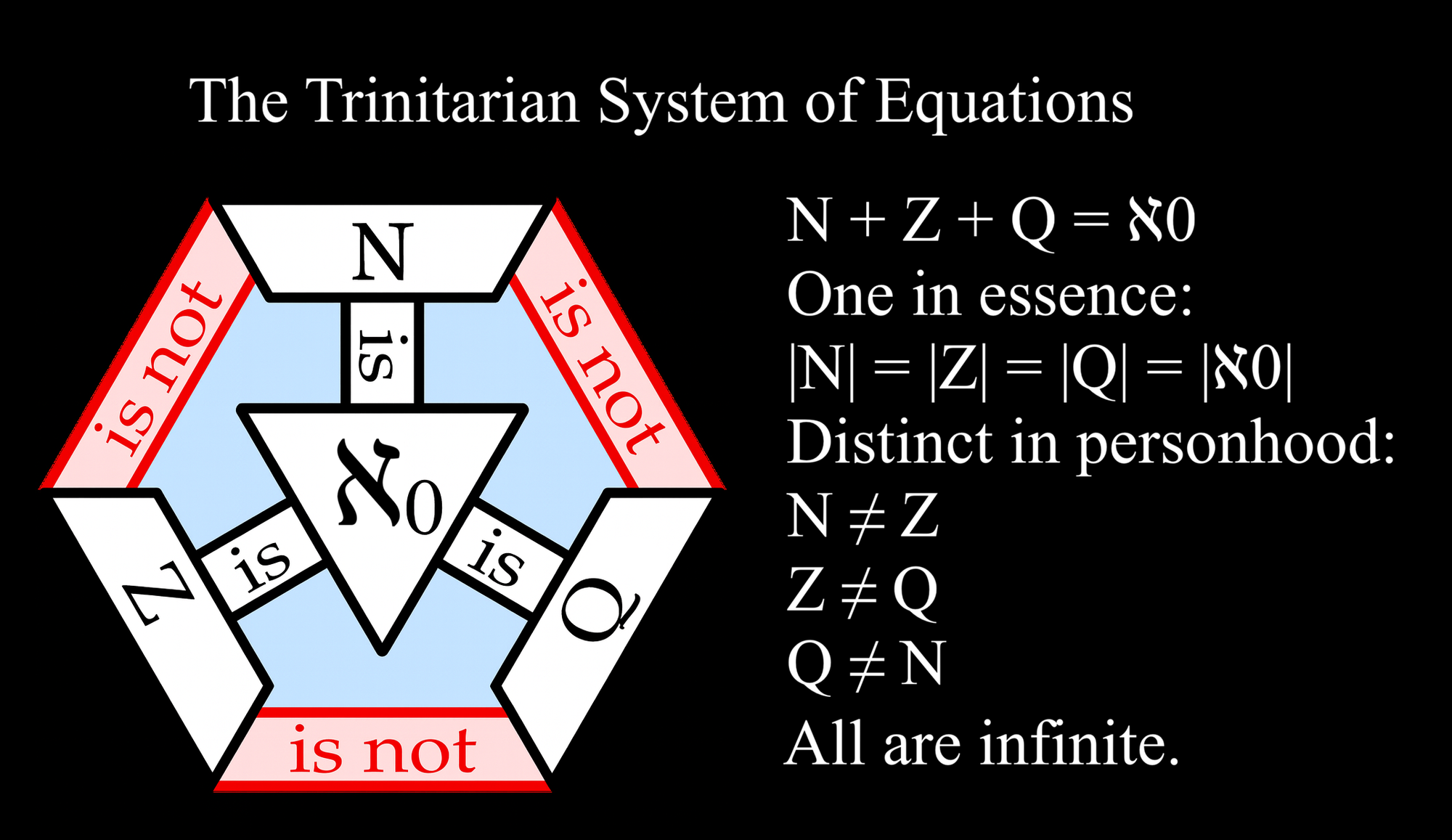
The Trinitarian System of Equations
This makes for one of the most deep and complex analogies for the Trinity, and I’ve personally never heard anyone point it out.
The infinite triune nature of God can be perplexing, to say the least. It’s one of the hardest theological topics to explain without sending someone’s head spinning in more than one direction. This deep and meaningful conversation, however, need not end with shrugged shoulders and the scratching of heads. While it may never be fully comprehended, it can be reasonably addressed, explained, and, as I have recently discovered, even modeled using mathematics. This article is not an attempt to demystify the Trinity. It is an attempt to do two things.
- Present a way for people to logically discuss the Trinity
- Acknowledge that it is indeed logically and mathematically valid for three infinite things to be one infinite thing whilst maintaining differences between them
Grappling with Infinity
Before we start throwing equations and symbols around, we need to ensure a basic and logical understanding of how and why we know God is infinite. Scripture states clearly in Colossians 1 that Jesus, being God and the image of God, pre-exists all things.
Colossians 1:15-18
15 [Jesus] is the image of the invisible God, the firstborn of all creation. 16 For by him all things were created, in heaven and on earth, visible and invisible, whether thrones or dominions or rulers or authorities—all things were created through him and for him. 17 And he is before all things, and in him all things hold together. 18 And he is the head of the body, the church. He is the beginning, the firstborn from the dead, that in everything he might be preeminent.
Many Old Testament passages establish that God is eternal or “everlasting” (Psalm 90:2, Psalm 93:2, Isaiah 43:13, Habakkuk 1:12). To my surprise, I found—years ago—that the ancient Greeks had come to the same conclusion by way of logic and philosophy, despite what history school books had taught me. Given the way it is written, it can be confusing the first time you read it but don’t worry, I’ll explain what’s important.
Plato, Timaeus, Critias, Cleitophon, Menexenus, Epistles: English Text, ed. G. P. Goold, trans. R. G. Bury, The Loeb Classical Library (Cambridge, MA; London, England: Harvard University Press, 1929), 49–51.
"Now first of all we must, in my judgement, make the following distinction. What is that which is Existent always and has no Becoming? And what is that which is Becoming always and never is Existent? Now the one of these is apprehensible by thought with the aid of reasoning, since it is ever uniformly existent; whereas the other is an object of opinion with the aid of unreasoning sensation, since it becomes and perishes and is never really existent. Again, everything which becomes must of necessity become owing to some Cause; for without a cause it is impossible for anything to attain becoming. But when the artificer of any object, in forming its shape and quality, keeps his gaze fixed on that which is uniform, using a model of this kind, that object, executed in this way, must of necessity be beautiful; but whenever he gazes at that which has come into existence and uses a created model, the object thus executed is not beautiful. Now the whole Heaven, or Cosmos, or if there is any other name which it specially prefers, by that let us call it,—so, be its name what it may, we must first investigate concerning it that primary question which has to be investigated at the outset in every case,—namely, whether it has existed always, having no beginning of generation, or whether it has come into existence, having begun from some beginning. It has come into existence; for it is visible and tangible and possessed of a body; and all such things are sensible, and things sensible, being apprehensible by opinion with the aid of sensation, come into existence, as we saw, and are generated. And that which has come into existence must necessarily, as we say, have come into existence by reason of some Cause."
This writing by Plato, an argument made by Timaeus, has stuck with me for years. That which is infinite has no beginning or ending, and does not change. It is never becoming something. It simply is. It simply exists. Anything else is finite and thus has a beginning and, in a sense, many endings, for it is always changing—always becoming and never finally is (or stays the same). You should probably take a moment to consider this on your own, before I explain it further. Once you take time to sit and think on it and grasp an understanding of it, it makes perfect sense. This is in total agreement with Scripture. Yahweh, the name of God, literally means “existing one”, one that “just is”; no beginning or end—no change.
Let’s put Plato’s words in simpler terms and logical sequence.
- Infinite means to exist with no cause, beginning, or end. It simply “is”, and as such does not change or “become” something else. It is without cause, for if something were to cause it to be then it would have a beginning and by definition not be infinite.
- Finite means to have a cause, a beginning, and an end, as well as to be ever in a state of change.
- Everything we observe in our universe is finite. Everything is always changing on a physical, chemical, and even visual level.
- Given that our universe is finite, it must have a cause and a beginning.
- The only thing that can be the cause for a finite universe is an infinite thing, for only something without cause or beginning can pre-exist all which has a cause and a beginning.
- This means that an infinite creator is a logical necessity for the existence of our finite universe.
From a standpoint of apologetics, one must go further to show that this infinite cause of the universe is the God of the Bible, which is beyond the scope of this article. One need only confirm that Jesus is who He says He is, historically and otherwise to find this to be the case, though there are many logical and empirical ways to come to such a conclusion. Again, the goal right now is to provide terminology and concepts for reasoning about the Trinity and evidence of its logical validity.
The massive question that remains is the complex nature of the Trinity, especially from a traditional Trinitarian understanding, which states that God is one in essence and three in persons. How can one ever wrap their head around such a concept?
Bad Analogies and Convincing Heresies
Some use the analogy of water. They say that water can have 3 forms, liquid, vapor, and solid. This, however, is technically a heresy known as Modalism. Understanding the Father, Son, and Holy Spirit as simply different modes that God changes in and out of is not accurate to Scripture and diminishes the distinct natures of each of the Godheads.
Some use the analogy of an egg. The shell, the white, and the yoke of the egg are all 3 parts of the same thing. This, unfortunately, is also a heretical understanding, though often an honest attempt to understand. This is known as Partialism, the belief that God is somehow divided into three parts. This ignores the both the deep oneness of essence and the genuine distinction between each Godhead. They are not parts of one God. They are all fully God. Again, this can be so confusing, especially with the limitations of our language, but clarity will be provided.
Others use the analogy of the sun, describing the Father as the sun, Jesus as the light and the Holy Spirit as the warmth. This heresy is known as Arianism. The Trinity, it so happens, is more complex than such examples that end up leading to false teachings and understandings. So what does Scripture actually say?
The Trinity According to Scripture
God the Father, Jesus the Son, and the Holy Spirit are all distinct in personhood and one in essence. They perform different roles, but are united in who they are.
Jesus says "I and the Father are one," in John 10:30. In Acts 5:3-4, we see Peter first saying that Ananias lied to the Holy Spirit and then, while questioning Ananias, stating that it was God that he had lied to, making God and the Holy Spirit one. Galatians 4:6 says, "God has sent the Spirit of his Son into our hearts." Given that it is the Holy Spirit that was sent, we know that the Holy Spirit and the Spirit of Jesus are also one.
While the Father, Son, and Holy Spirit are all one in essence, they are also distinct in personhood. They all have different roles, which naturally require certain differences.
- Humanity: Both God and the Holy Spirit cannot die and are not human, so they could not pay the cost of sin for humanity.
- Jesus is fully human (John 1:14, Philippians 2:7) and fully God (Colossians 2:9), which allows Him to be sinless and yet die as a human, paying the cost on our behalf (2 Corinthians 5:21, 1 Peter 2:22).
- Temptation: God the Father cannot be tempted (James 1:13), but Jesus was tempted (Mark 1:13).
- Knowledge: God knows all things (1 John 3:20), while Jesus and the Holy Spirit know only slightly less (Matthew 24:36).
While Scripture is clear about the Trinity, that does not mean it is easy to understand. Many would still say, it seems obvious that 3 is not 1 and 1 is not 3, nor can they be the same. With simple addition this is true, but not too long ago I stumbled upon something in higher-level math that clicked in my head. When I was studying infinity in mathematics, I became fascinated with ℵ0 (aleph-null) and realized that it had the potential to somewhat accurately model the Trinity mathematically. You see, it is a mistake to think that comparing the number 3 to the number 1 is a valid representation of the trinity, because such numbers are finite. God is infinite. If you want to make sense of God mathematically, you must use what tools we have in mathematics that can best describe what we know about Him.
The Equations
Confusing high-level short answer:
In mathematics—according to ZFC set theory, Zermelo-Fraenkel set theory with the Axiom of Choice—a singular infinity can consist of 3 forms of infinity at once whilst none of them equate one another. This makes for one of the most deep and complex analogies for the Trinity, and I’ve personally never heard anyone point it out. So, allow me to explain this mathematical model and how it can help us understand how a Trinity of one God can genuinely be reasoned about.
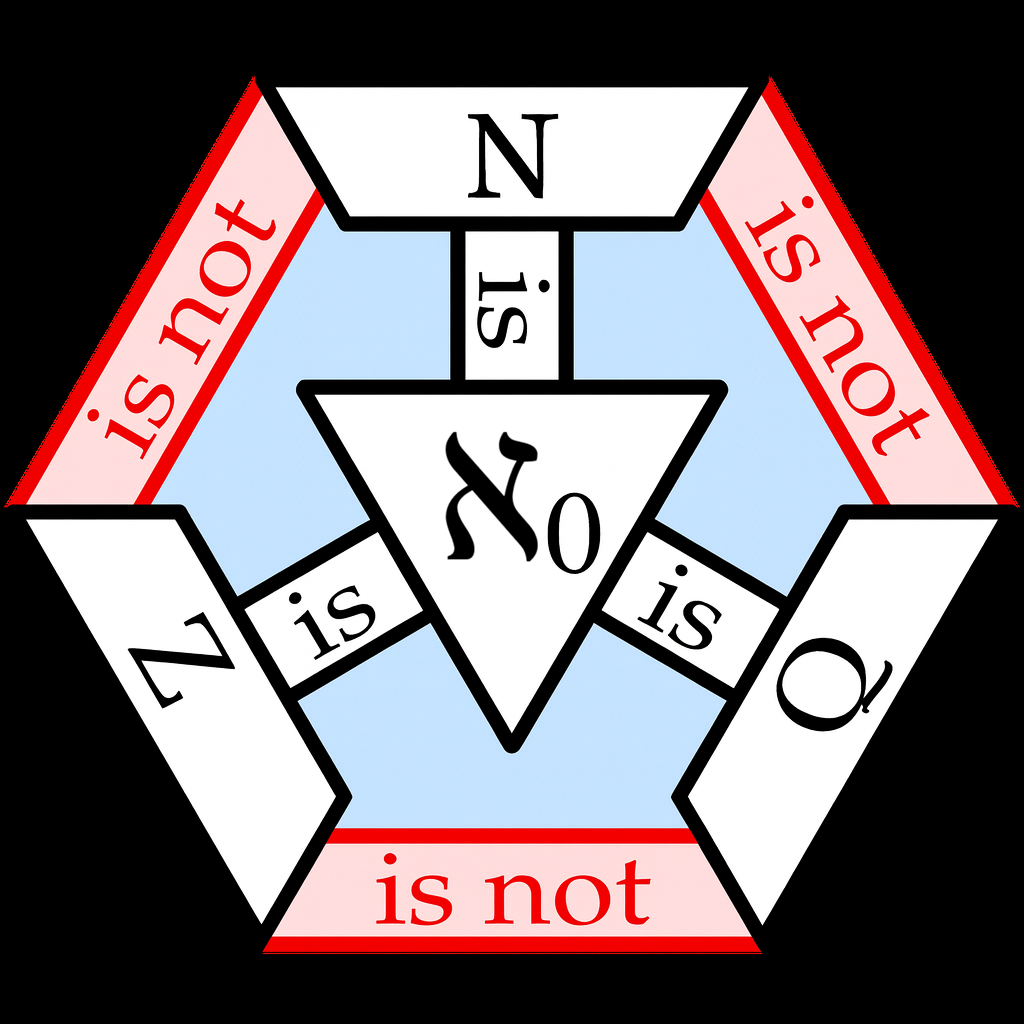
This is what I’m calling the Trinitarian System of Equations (TSE), or the Trinitarian Equations for short.
The Trinity (N + Z + Q = ℵ0):
Is distinct in personhood (different infinite number sets):
- N ≠ Z
- Z ≠ Q
- Q ≠ N
And one in essence (cardinality): |N| = |Z| = |Q| = |ℵ0|
Where N is the infinite set of all natural numbers, Z is the infinite set of all integers, and Q is the infinite set of all rational numbers—ℵ0 (aleph-null) being the infinite set consisting of all three as one.
Maybe these equations look intimidating, or maybe you’re surprised at how simple they are. Both are valid perspectives. If you don’t understand how infinity works in mathematics, I highly recommend watching this video before continuing. Josh does a great job explaining these concepts visually and it will make the rest of this make a lot more sense.
These two equations describe a single infinite set of numbers that are technically three distinct and overlapping infinite sets of numbers; where three are one and all are infinite. This is not Partialism because ℵ0 is a singular infinite set, and N, Z, and Q are all already infinite, none of them are a fraction of infinity. It isn't 1 + 1 + 1 = 3, it's ∞ + ∞ + ∞ = ∞. It is not Modalism, because none of these sets are modes of the others. It is not Arianism because this system of equations doesn't describe any process of emission. This equation agrees with the traditional Trinitarian understanding of a singular God consisting of three different Godheads. A singular infinite set of numbers that is three distinct infinite sets of numbers, sharing numbers between each other without being equivalent in meaning or role.
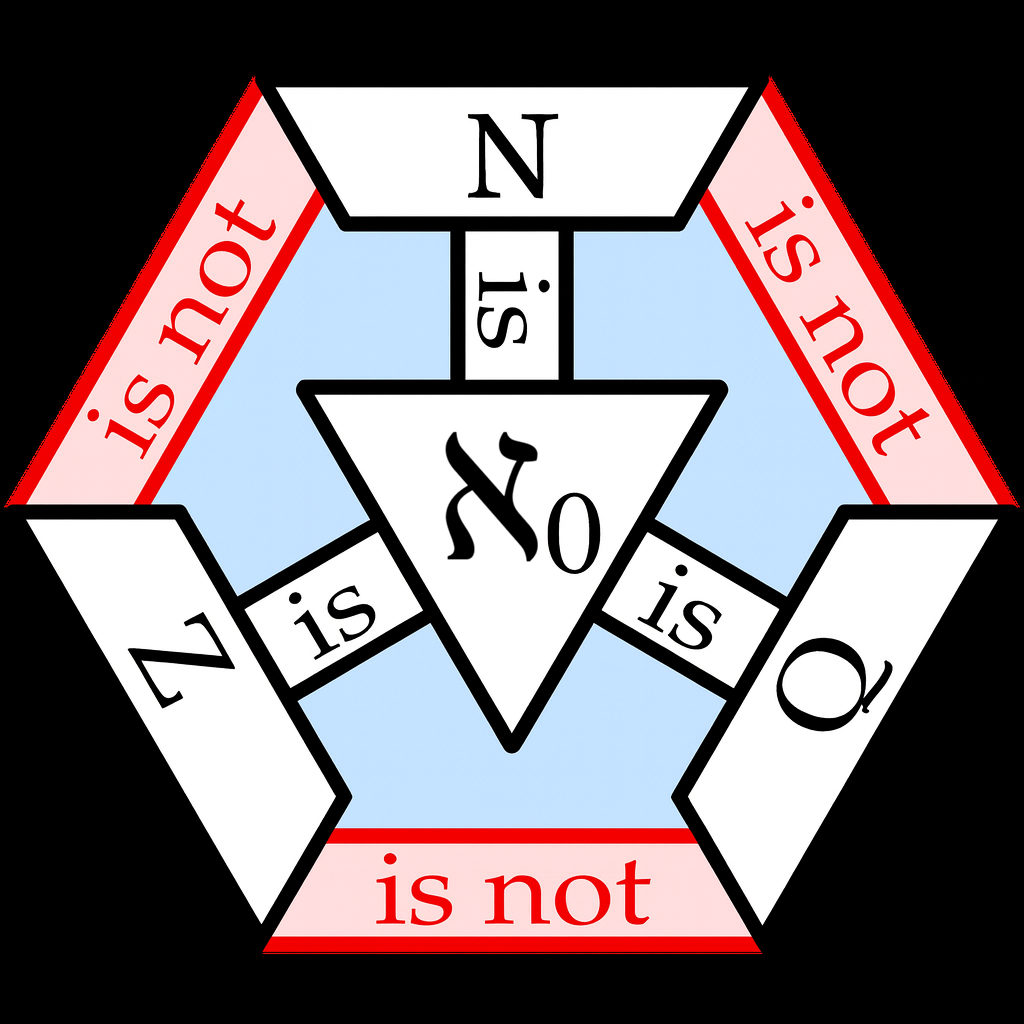
Further Explanation
Oneness in Essence (Shared Cardinality)
The concept of cardinality in mathematics is a remarkably powerful analogy for explaining the concept of essence in the Trinity. Not all unique infinite sets of numbers can coexist in a single infinite set of numbers, in other words not just any 3 infinities can be 1 infinity. They must share what is referred to as cardinality. In a sense, they must be of the same infinite essence. The infinite set of irrational numbers, for example, could not be included in ℵ0 because it has a different cardinality. The equation works because N, Z, and Q all share the same cardinality: |N| = |Z| = |Q| = |ℵ0|
This is a fascinating analogy of the essence of the Trinity. The Father, Son, and Holy Spirit can all be one because they share cardinality, they are of the same type or essence, they are one (Deuteronomy 6:4).
Distinct in Persons (Differing Sets)
Natural, rational, and integer numbers all have different roles to play in mathematics. These infinite sets contain different numbers, some shared and others unique to themselves. Thus, like the Trinity, their roles are different but also overlap with one another: N + Z + Q = ℵ0
They do not equate one another: N ≠ Z, Z ≠ Q, and Q ≠ N
They are different, but they are still one in essence.
To be clear, this does not demystify the Trinity. It emphasizes the beauty, complexity, and reality of the Trinity. This is not a concept that is beyond discussing in detail. We can see proof of the possibility of 3 infinities being 1 infinity simultaneously, all consisting of differences whilst being one. We can see that while this concept is bewildering, it is not illogical. Triunity of infinity is a logically and mathematically valid concept.
Conclusion
In conclusion, the aforementioned equations can be used as a reasonably accurate system for understanding how an infinite triune God can possibly exist in such a state. If you find yourself asking, but “where did the Trinity come from?” I will remind you that is like asking what the color red smells like. It makes no more sense to ask what smell is emitted from a concept that does not emit a smell than it does to ask of the beginning of something that by definition does not have one. While the system of equations remains only a blurry shadow of the multidimensional reality, knowing it is valid—and how it works—in mathematics opens the door to logically addressing the ontology of the Trinity.